- "Sustainable Logistics – Partnering to Shape the Future": More than 650 industry decision-makers discuss innovative logistics solutions at event showcasing the future of retail.
- Exclusive insights: Kaufland demonstrates fully automated food order picking solution at logistics site.
- Integrated ecosystem: Smart interplay of innovation, people and environment safeguards sovereignty and future-proofs global flows of goods.
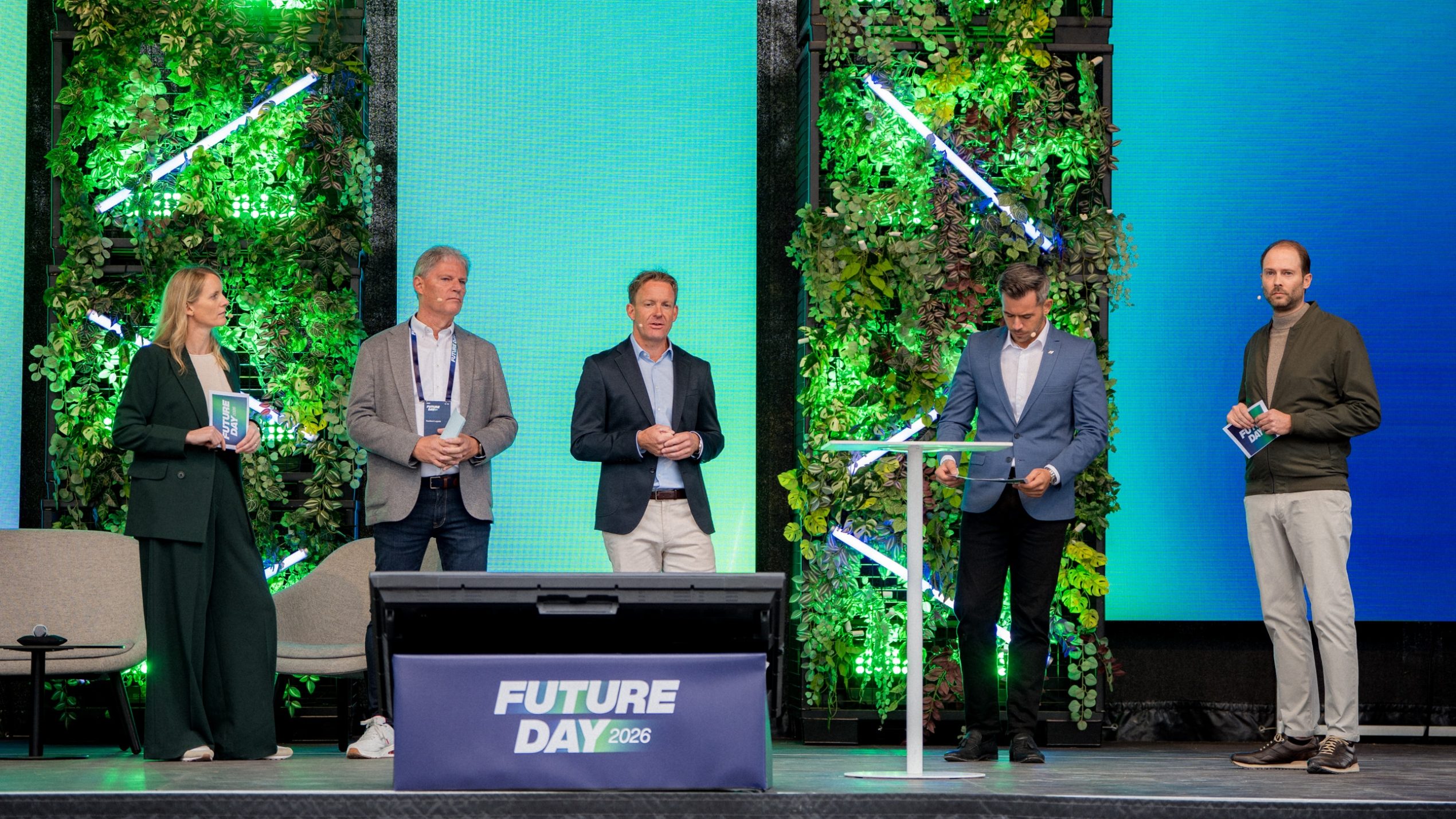
The companies of Schwarz Group held their second Future Day, this year at the Kaufland logistics center in Geisenfeld on the theme of "Sustainable Logistics – Partnering to Shape the Future". More than 650 industry decision-makers and innovation leaders experienced first-hand the Group's great strength and unique features: From retail (Kaufland, Lidl), through production (Schwarz Produktion), down to the circular economy (PreZero) and digitalization (Schwarz Digits), the companies of Schwarz Group and external partners bring their expertise to bear transforming complex logistics challenges into strategic opportunities. Future Day offered a forum to discuss technologies, infrastructure, working environments and specific, practical solutions. At one of Europe's most advanced logistics centers, event host Kaufland gave exclusive insights into state-of-the-art logistics processes, such as fully automated food order picking.
"When it comes to transforming logistics, we're not waiting for ready-made solutions, we're developing them ourselves in cooperation with the other companies of Schwarz Group and our partners. That's exactly what we're demonstrating in Geisenfeld with our highly automated logistics center – a game-changer in terms of long-term viability”, said Pascal Siegmund, Vice President Logistics International at Kaufland Stiftung. “We're also driving forward e-mobility in our logistics operations and installing charging stations for e-trucks at all of our logistics sites. At the same time, we aim to slash empty runs and wait times by interlinking data and using it to build and expand transport networks. Ultimately, everyone benefits: Our partners and, above all, our customers thanks to efficiency gains in delivering goods to our stores.”
One Ecosystem, One Goal: Future-Proofing Supply Chains
Efficient, lower-emission and resilient logistics cannot be achieved in isolation. It requires a combination of human expertise, technological innovation and long-term partnerships. At the 3,800+ sqm. facility hosting Future Day, participants discussed specific solutions to the industry's most pressing issues.
1. Innovation and automation: Real-world applications instead of pipe dreams
The companies of Schwarz Group are transitioning cutting-edge technologies directly into their day-to-day operations: In partnership with Einride, Lidl became Germany's first food retailer to deploy a cabless e-truck with self-driving capability on the country's public roads. Participants at Future Day 2026 saw the truck in action for the first time during a live demonstration. At logistics centers, AI-enabled gripper systems are handling the repalletizing of complex product ranges, and inspection robots are being tested out for quality and inventory control. Data-driven demand planning avoids supply bottlenecks and helps pinpoint exactly where to minimize excess stock and food waste. The STACKIT European cloud platform from Schwarz Digits ensures the digital sovereignty and cybersecurity of these highly interconnected supply chains.
"Our logistics network is the central hub of our ecosystem," explained Maverick Malcher, Vice President, Schwarz Mobility Solutions. "Smart technologies and data governance make our supply chains agile and resilient. We're bringing innovation directly into day-to-day operations across all divisions, safeguarding the flexibility and future viability of our supply chains."
2. Humans in the work environment: Technology as a solution to the shortage of skilled workers
Given the persistent shortage of skilled workers in logistics and demographic change, the companies of Schwarz Group are redefining the role that humans play. Smart robotics and fully automated food order picking are taking over physically demanding sorting and routine tasks, and at the same time autonomous systems are transitioning job roles in logistics towards expert oversight. Humans remain in the driver's seat when it comes to judgment calls, responsibility and change management. Through their own initiatives such as the PreZero Driving School, the companies train and develop pools of young talent and skilled workers throughout Germany, both for themselves and for external partners. In addition, Lidl leverages its membership of industry forum the Food Retail and Food Industry Sector Dialog (Branchendialog Lebensmitteleinzelhandel und Ernährungsindustrie) to actively advocate for binding social standards.
3. Decarbonization and the Circular Economy – Sustainable Business Practices in Logistics
On the path to net zero by 2050*, the retail group is dovetailing the action being taken. In addition to optimized capacity utilization and smart route planning, the companies of Schwarz Group are focusing on lower-emission drive technologies: Lidl in the Netherlands, for example, is switching to e-trucks only for its store deliveries by 2027. PreZero is gradually transitioning its waste collection fleet to alternative drive technologies, while Kaufland is having high-capacity charging stations installed at all of its distribution centers in Germany in an effort to drive forward more widespread use of e-trucks. Efficient recycling loops safeguard the Group's resource sovereignty in the long term. To this end, the distribution centers, for example, are systematically sorting their recyclables in line with the Road to Zero Waste target. Another example is Schwarz Produktion's PET recycling loop.
"We will only succeed in transforming logistics if we take a holistic approach to technology, infrastructure and partnerships. We are switching to electric vehicle fleets, establishing circular material lifecycles and making targeted investments in innovation. Together with our partners, we are demonstrating that future-proof logistics is the key to economic strength," said Florian Schütze, Senior Vice President for Corporate Responsibility at Schwarz Corporate Affairs.
Schwarz Group's Logistics Network
- Europe's biggest retail group: A highly complex, integrated logistics and value network in cooperation with strategic partners
- Retail and logistics network: Around 250 logistics and distribution centers meeting the daily delivery needs of more than 14,500 stores (Lidl and Kaufland) in 33 countries
- In-house production: 19 in-house production plants operated by Schwarz Produktion form the basis for the private label product range
- Circular economy: PreZero operates a waste management fleet at around 470 locations
- Maritime logistics: Tailwind Shipping Lines is Lidl's own shipping company, with a fleet of 11 vessels
The Kaufland Logistics Center in Geisenfeld
- Goods traffic: 350 trucks per day
- Pallet intake: More than 8,000 pallets per day
- Level of automation: 80 percent of the food range is fully automated, 20 percent is handled manually (promotional items, bulky goods)
- Depalletizing: 70 percent automated by robots, 30 percent by hand at ergonomic workstations
- Dimensions: Racks just under 30 meters high, 100 meters long and 40 meters wide
- Floor area and capacity: Usable area the size of a soccer field, with space for up to 30,000 pallets (equivalent to, for example, 20 million rolls of toilet paper)
- Storage and retrieval machines (SRMs): 15 SRMs operating in parallel (throughput: 50 pallets per unit per hour)

