REset Resources

The Holistic Circular Economy Strategy of the Companies of Schwarz Group

Future-Ready Circular Economy

Through REset Resources, we leverage our ecosystem to shape a future-ready circular economy across all divisions.

In times of global instability and resource scarcity, we use circular processes to ensure access to important raw materials and the long-term viability of our business models. The circular economy therefore makes us more independent of global supply chains, minimizing our vulnerability to resource shortages. 

Through REset Resources, we want to jointly set new benchmarks for European resource sovereignty.

What Is REset Resources?

As our holistic circular economy strategy, REset Resources integrates responsible resource management into all business processes.

Through measurable targets and systemic change, we conserve resources, avoid waste and keep materials in the loop.

REset Resources encompasses all key areas from packaging and products to construction, food waste and innovative recovery processes, promoting the circular economy along the entire supply and value chain.

Together, the companies of Schwarz Group are committed to conserving resources and actively shaping the circular economy. Making the circular system work relies entirely on close cooperation. To do this, we leverage our ecosystem throughout the value cycle: from production and retail to recyclables management and digitalization.

Fields of Action and Objectives

The jointly developed REset Resources circular economy strategy is based on five specific fields of action:
 

REdesign: "We design our business models to align with circular economy principles."

  • Packaging target: We will make the packaging for our private-label products as recyclable as possible by 2030.

REduce: "We reduce the use of resources and prevent waste."

  • Packaging target: We will reduce virgin material in single-use packaging for our own brand products by 15 percent (absolute) by 2030.
  • Food waste target: The companies of Schwarz Group will reduce their food waste by 50 percent at group level by 2030 compared with 2018.

REuse: "We focus on reuse."

  • Packaging target: We will transition to nearly 100% multi-use pallets for our internal picking processes 2 by 2027.

REcollect: "We ensure access to recyclable materials."

  • Packaging target:We will collect and recycle the same quantity of recyclable materials as we put into circulation with our private-label packaging and our household leaflets by 2030.

REcycle: "We strengthen sophisticated recovery processes and increase the use of recycled materials."

  • Packaging target: We will use 65 percent recycled material in our private-label packaging by 2030. We will use 30 percent recycled material in the primary plastic packaging for our private-label products by 2030.

Sub-target: "Road to Zero Waste"

Target: By 2030, the companies of Schwarz Group will reuse, recycle, compost or ferment a total of 95 percent of their own operational waste.

  • In so doing, we exceed common target standards since we are deliberately excluding thermal recovery of waste with energy recovery (pursuant to the DIN SPEC 91436 definition) from our target.
  • The scope of this policy covers waste from all units of the companies of Schwarz Group, including stores, logistics centers, administrative offices and production sites; this excludes waste from the Group’s own recycling and disposal facilities, as well as construction waste.
  • In addition, a sub-target was established: The national companies of Lidl and Kaufland, as well as the PreZero central administrative offices, will be certified (by an accredited independent external auditing organization) pursuant to the DIN SPEC 91436 by 2030.

REset Resources – Conserving Resources and Practicing the Circular Economy

Through the holistic circular economy strategy REset Resources, we – the companies of Schwarz Group – examine all material flows throughout the entire product life cycle and design sustainable recycling loops.

Progress and Achievements in Fiscal Year 2025

REdesign

The companies of Schwarz Group are jointly establishing circular business models along the value chain. Above all, the focus is on the recyclability of packaging and products. This is of central importance since composite materials, for example, can currently rarely undergo highquality recycling. That is the reason that they are often subject to thermal recovery. In this way, valuable raw material is lost permanently. Furthermore, process-related carbon emissions are generated.

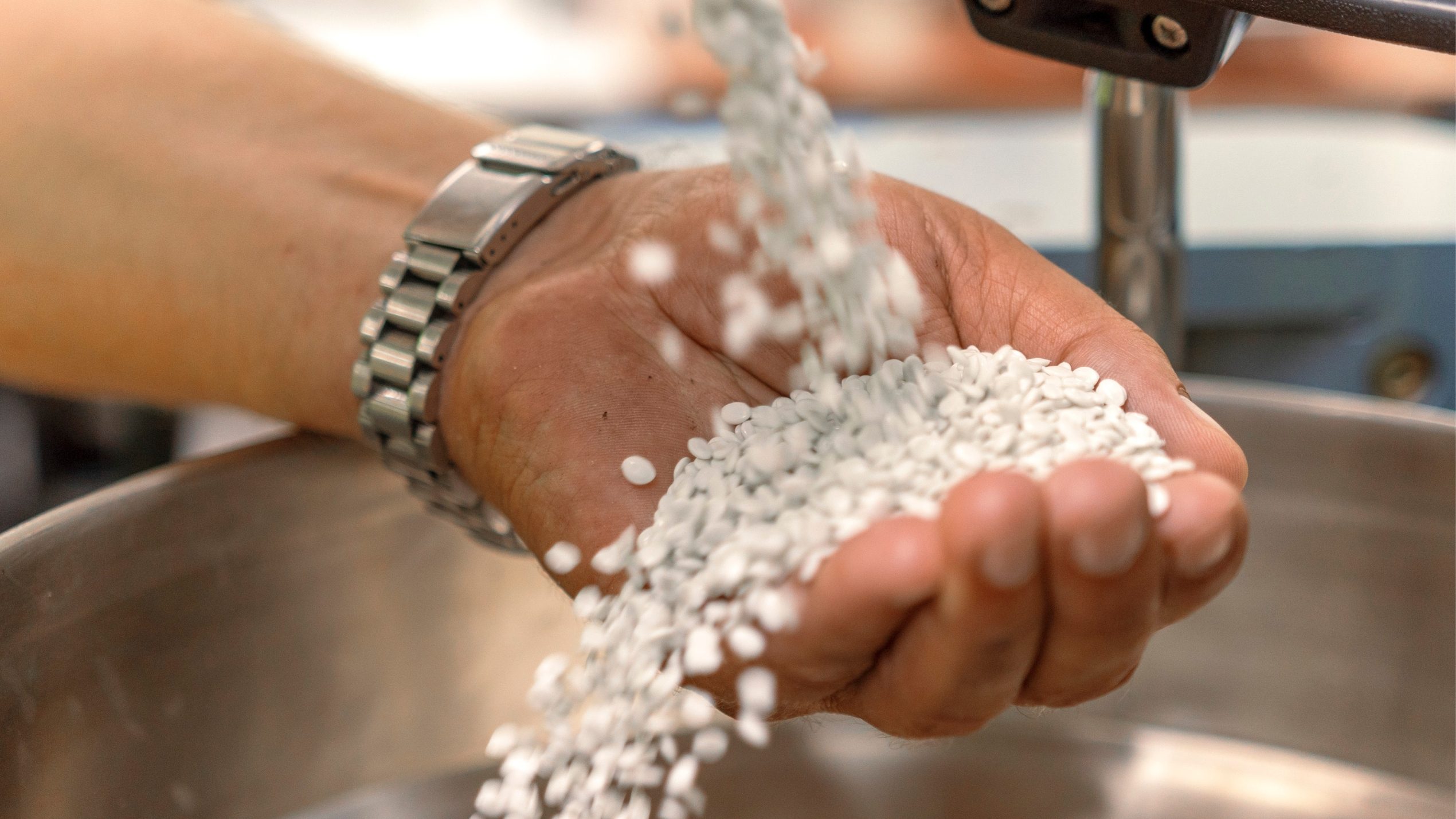
Against this backdrop, we are pushing forward with the transition to monomaterials, particularly in the area of plastic packaging, in order to improve sortability and recyclability. One specific example is the optimization of the “Fix-Tüten” – the soup and sauce pouches sold under Kaufland’s private label, K-Classic. The sachet is a multilayer package made from monomaterial. While adapting the packaging, Kaufland and PreZero jointly developed an innovative composite material with significantly improved recyclability. With appropriate waste disposal, the material remains in the recycling loop.

In addition to optimizing plastic packaging, we continuously evaluate the use of alternative materials such as paper or cardboard, provided they offer functionally equivalent properties. For example, the previous plastic cap on K-Classic air fresheners has been replaced with a cardboard version. As a result, approximately six grams of plastic were saved per lid compared to reference projects.

We also apply the REdesign approach in non-food areas. We systematically analyze our textile portfolio to assess its recyclability. In addition, we have developed a style guide for recyclable textiles in cooperation with the Institut für Textiltechnik (ITA) of RWTH Aachen University (see also Material Style Guide for Recyclable Textiles).

REdesign Strategie der Unternehmen der Schwarz Gruppe

FAQ on the Circular Economy and REset Resources

  • REset Resources is the holistic circular economy strategy of the companies of Schwarz Group. 
  • With REset Resources, the companies of Schwarz Group are expanding the scope of their jointly developed plastic strategy, REset Plastic. REset Resources considers all material flows and the entire product life cycle. 
  • A particular focus of REset Resources is on expanding the REset Plastic packaging targets to include not only primary plastic packaging, but also all other types of packaging and packaging materials moving forward. In addition, REset Resources places a strong emphasis on avoiding food waste and ensuring the accurate sorting of recyclable materials.
  • The goal of REset Resources is to promote the circular economy along the entire supply and value chain — not only within the internal processes of the companies of Schwarz Group, but also among their partners and suppliers.
  • Example measures include reducing the use of resources, promoting reuse, improving recyclability, ensuring access to recyclable materials and increasing the use of these.
  • Statutory requirements as well as the global scarcity of strategically important resources are increasingly putting the spotlight on a functioning circular economy.
  • By further developing REset Plastic into REset Resources, the companies of Schwarz Group are proactively preparing to meet future regulatory requirements,​ while also strengthening cross-divisional collaboration.
  • With the holistic circular economy strategy REset Resources, the companies of Schwarz Group are leveraging their ecosystem to shape a future-ready circular economy in their target countries. In this way, they are minimizing their vulnerability to resource shortages and protecting themselves against supply bottlenecks.
  • In the circular economy, generated waste is managed according to the principle of cascading use. With this approach, the focus is on preventing waste in advance, extending the lifespan of products as much as possible and putting the resources used during production back into the loop once a product’s lifespan has come to an end.​ This ensures that resources are conserved as effectively as possible and used for as long as possible.
  • REset Resources covers all key areas of the circular economy: from packaging and products to construction, food waste, recyclables management and recovery processes.
  • The REset Resources packaging targets cover all types of packaging and all packaging materials.